


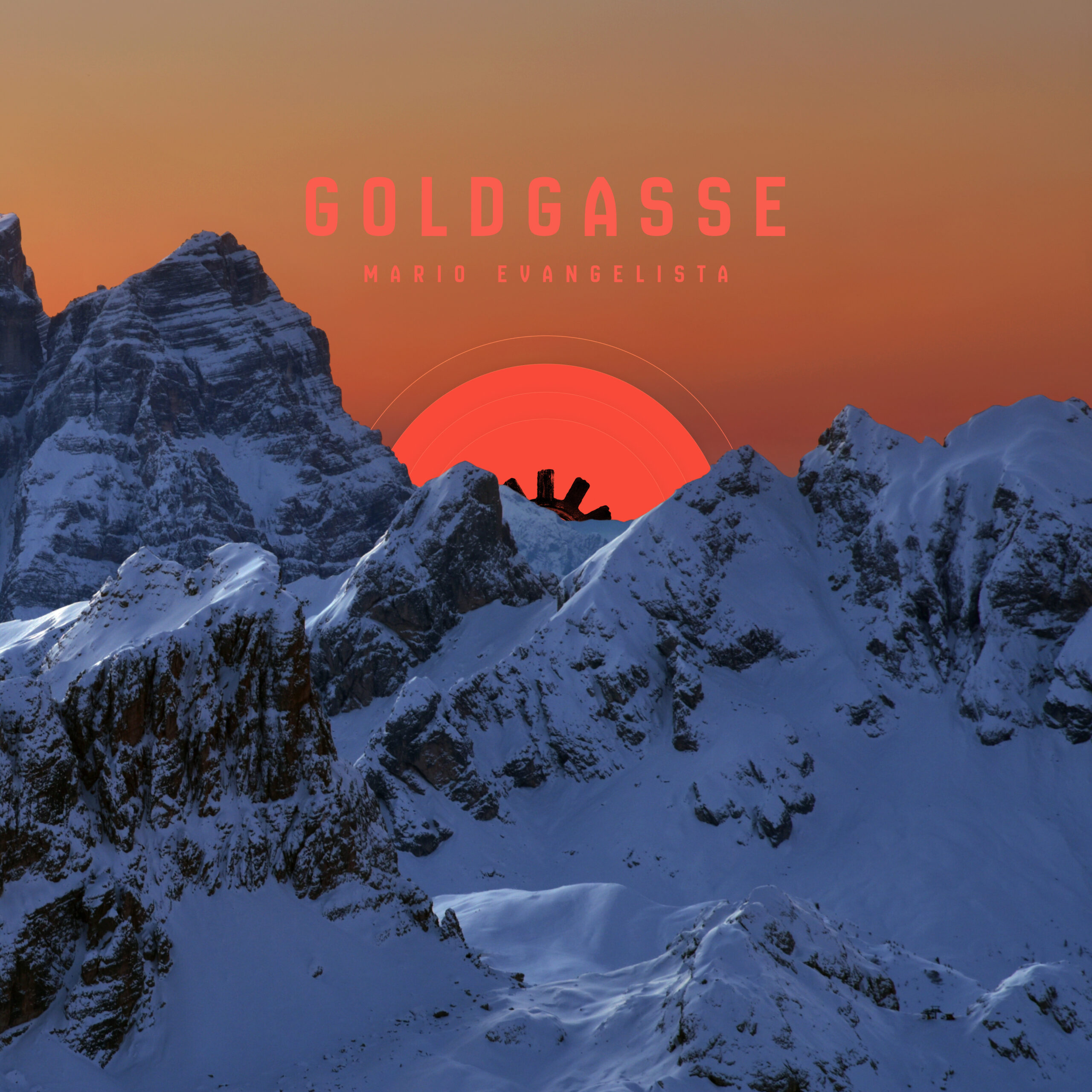
Goldgasse, or Via dell’Oro, is a historic alley located in the village San Michele (Appiano), situated along the famous South Tyrolean Wine Road. Goldgasse is also the title of the project and the related album born from the collaboration between Mario Evangelista – a musician, composer, arranger, and multi-instrumentalist for twenty years, active also in the bands Pitchtorch and The Gutbuckets, as well as in Collettivo Jambona – and Kern, a Italian real estate development company that designs and builds luxury residences, transforming forgotten places with hidden value into contemporary spaces where history and design coexist.
The Goldgasse real estate project, nearing completion, will create an exclusive renovated historic residence in the heart of San Michele. Kern doesn’t just build houses; it’s a creative factory that designs and creates living spaces. Kern Studios is its expression dedicated to music, and will lead to the creation of a record label dedicated to quality, vinyl, and the art of listening. Producing a record isn’t a detour but a natural evolution: after all, sound, too, is a space to be designed. So, Kern asked Mario Evangelista to compose and arrange music capable of depicting the Goldgasse project and its surrounding areas, close to some of the most evocative peaks of the Dolomites. Leaving him completely free.
Goldgasse is the first album released by Kern Studios, out today October 23, 2026 on vinyl and digital.
According to Evangelista: «For many years I have wanted to get involved in writing a soundtrack. When Kern contacted me, it was a big surprise because the album commission opened up scenarios that I didn’t even think I could imagine. I composed instrumental tracks that highlighted a coherent and harmonious fusion between ancient and modern elements, as in Kern’s style. To do this, I used synthesizers, acoustic and electric guitars, electric bass, pedal harmonium, pedal steel, percussion, and so on. I wanted to insert both the acoustic and “traditional” aspect of the guitar, as always with multiple tunings, and a certain type of electronics thanks to synths and digital manipulations».
Inspiration came also from the well-known King Laurin’s legend, which explains the optical phenomenon of alpenglow (from Italian: enrosadira), that is the turning pink of the Dolomites at dawn and sunset. Each of the tracks is inspired by the places and characters of the legend, with the only exception of Baturla, a term that comes from the Tuscan dialect and represents the gurgling sound that storms make just before breaking out.
In the opening track Enrosadira, Evangelista captures the wonder of the pink colour that unexpectedly invests the Dolomites, when the movement of the light is almost imperceptible and the explosion arrives when the sun finally shows itself in all its beauty. The title track Goldgasse evokes the new life and the balance between history and design of the houses in the village of Appiano (Eppan). The track titled Eppan reveals a melody with subtle references to Bach’s counterpoint and the indolence of the blues, and pays homage to the solemnity of the village, nestled against the mountain.
The lead single Laurin is dedicated to King Laurin, the character from the most classic legend of the Dolomites. His imposing presence is conveyed by the rhythm of the electric guitar combined with delay, creating the sound image of his earth-shaking footsteps, while his voice is expressed by a synth line that leaves room for imagination.
Near to the mood of the Kantian sublime, Rosengarten refers to King Laurin’s rose garden, which he manages to hide from others thanks to his magic belt, but the Rosengarten group is also a massif in the Dolomites. Between edges of melody and more reassuring moments, Similde takes its name from the eponymous princess who represents for Laurin a mad love.
The album’s focus track Die Klüss is named after Klüss, the “key” that is the essence of Kern, that is what arises from the unprecedented encounter of two forces — the energy of those who transform forgotten spaces into value and the people who inhabit those spaces— and becomes the means capable of uniting them, bringing ecosystems and communities together. The track contains multiple themes that generate a dialogue, contributing to a harmony reflecting the project’s multiple souls.
The album was recorded, mixed, and mastered by Antonio Castiello at Jambona Lab Studio. Elisa Bruni was involved in the artwork, while Erica Salvi took the photography, including the cover shot.
Goldgasse is the furthest achievement from anything previously produced by the Italian musician active in Florence, whose solo career began last May with the debut album Da Capo, an imaginary series of sound paintings for acoustic guitar, but at the same time it is a natural maturation that represents who Mario Evangelista really is nowadays.


